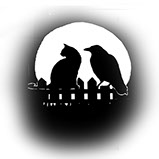
The Legend of the Black Swans
By Magnolia Robichaux
West of the White Mountains lie hundreds of miles of untouched land known as Karvina. People have avoided the vast spreads of land here due to the wolves that make the forest their home. Fear of these beautiful creatures has kept the region uninhabited, as any disappearance is always blamed on them.
In this isolated wilderness is a circle of rolling green hills surrounding a small valley. In this valley, along the banks of a pond we call The Sapphire, are the cottages where my clan and I live.
In the white winter months, everything is still. Our stone chimneys send wisps of smoke into the grey skies, and our little cottages, with their golden glowing windows, are encircled by the half buried paw prints of the wolves and tracks of birds and rabbits in search of food. In the warmer months our bonfires border the pond, and we live outside cooking, dancing, playing music and telling the stories of our clan, their legendary love affairs and the exotic lands they travelled through.
Each of our unique cottages was crafted by hand almost 200 years ago by Wiflin and Leighlabelle Labada, two of my Gypsy ancestors. The siblings had been part of a nomad tribe travelling the wilderness and towns of Europe.
The events describing how our homes and The Sapphire came to be were written by Leighlabelle and have been passed down through the generations. The story is now in my possession, and I am its guardian until I pass it on to my children. Here is that story, faithfully translated from her own hand, just as it happened.
***
The snow has been falling all day, and the world is peaceful. I have settled in front of the fire with Wiflin beside me, his old hands moving softly across the ivory keys of his accordion. Wiflin’s blue eyes sparkle as he looks from the fire to me. When our eyes meet, it strikes me that I need to write the story of this great man - our story - and I would begin this very night.
The Voices of the Lebada Clan Sing Eternal
This gift is for my family. It is the story of your ancestors and the Lebada village you live in.
Our clan name, The Black Swans, stems from our family name, Lebada - an ancient word meaning swan. Our clan crest of two black swans facing each other with their necks intertwined and the words “We Remember” written in the scroll above them was first carved over a hundred years before the events relayed here occurred.
The story begins early one autumn evening when we pulled into town, the last stop on our journey across the country before winter set in. It was raining lightly; a downpour had just ended and the streets were thick in mud and water. Some of the ruts were so deep that several of the men had to jump out and push to help our overtired horses pull the caravans safely through.
We chose a deserted square at the edge of town to set up camp. Leading the horses, the men backed the caravans in to form a circle with just enough space in the center for bonfires, cooking, meeting and dancing. The sun managed to break through before setting, and the rest of our clan emerged from their colorful hand-painted doorways, smiling and stretching, happy to get a glimpse of its light and feel its warmth again. Steam was rising from the backs of the horses, and my little brother, Wiflin, and I ran between them, caravan to caravan, opening all the shutters to let the fresh air blow through.
A few of the men began building a fire with wood Wiflin and I had helped to collect. Knowing the rain was coming, we spent a day filling one of the caravans with fallen branches and pieces gathered from the woods just outside of town; although, Wiflin and I spent most of the time just playing. . Before long, the fire was sending sparks high into the night sky.
We settled in, and as the last of the sunlight disappeared, I heard the mournful, soothing sound of a harmonica. I joined the others around the fire to listen to this rare and unusual instrument that had cost my uncle one of his horses in trade when we were passing through Vienna last spring. We sat quietly listening as the last note lingered and faded into the crackling of the fire. My uncle paused and gazed into the flames for a moment before breaking into a lively ancestral song. The others joined in, sending their voices and instruments into the evening air.
The song over, a crescent moon appeared with just enough light to reveal towering black clouds in a sea of stars. Moved by the beauty of the night, the men and women forgot their hunger and joined together for a dance.
My mother and the other women circled the fire - so beautiful in their rich embroidered dresses and red silk roses in their hair. They tapped out patterns in unison, creating the rhythm of the dance: their moves a thousand years old, their meanings passed down from our ancestors.
The men joined them, mirroring their steps. Pairing off, they hooked arms and slowly spun several times before releasing each other and pausing in silence. Then, quietly, they built into the ebb and flow of a new rhythm as the men clapped and the women, with their arms straight out from their sides, tapped their feet in answer. Adding to the back and forth of their rhythms, the women snapped their fingers - their bejeweled hands first bent downward, then slowly swirled at the wrist.
Moving in close, the women wove their arms upward through the air like flowing liquid as the men held their waists; all their feet now a blur. Finishing with heads bowed and figures proud, tonight they didn’t dance the dance of joy but chose instead the dance of love.
My father was a tall, thin man, always dressed in black. Deep-red ruby buttons lined his fitted satin vest and the long cuffs on his billowing sleeves. His fingers glittered with rings, and he had the tattoo of our clan crest on the palm of his hand, just as I had on mine. He wore a black felt hat over a single braid of thick, black hair that reached to his knees. I mused that he would be hard to see in the dark if not for the fire reflecting off of my mother’s colorful scarves. It was as if he were lit by a rainbow.
I huddled in close to Wiflin as he played the accordion. It was a gift from our grandfather, and although it was still too big for him, my brother wanted to play nothing else. My uncle said his small hands were able to make it sing like no one had before. As we watched everyone dance, the remaining clouds cleared and the stars spread across the sky like a glittering carpet.
***
In the early hours before dawn, we were torn from our sleep by the sound of shouting. I pulled the curtain from my window and saw a gilded carriage across the road, overturned in the mud. Two members of what seemed to be the royal family stood shivering nearby - their white horses rearing and screaming from the severe whipping the servants were giving them. There were streaks of blood on their flanks and the dark form of someone in the mud that the horses had knocked down.
My father and several of our men ran over, grabbed the servants by their wrists and stopped the beatings. Resenting the interference, fighting broke out, but the servants were no contest for our people.
After the horses were calmed and tended to, the men from our clan lined the side of the carriage, righted it and lifted it out of the rut. A couple of our women cleaned mud from the seats and helped the family back in. The servants were harshly reprimanded, and all but the driver were told to find their own way back as the carriage and horses pulled quickly away. Our men offered peace and invited them for a warm drink and the use of our horses, but the servants spat threats and foul insults before heading back toward town on foot.
***
The next morning, we were all cold and hungry. Mother said that my brother and I should go into town to see if we could find some meat and food for everyone; we needed to build our strength for the dances and entertainment of the evening, as we were low on money and needed to perform.
She gave us some of the beautiful scarves that she had made to trade. They were richly colored, a few were purple and gold, several were shades of green and blue, others woven with fiery oranges, yellows and reds; some had narrow strips of thin metallic ribbons woven through, and they all glittered with intricate beadwork. Her scarves were highly coveted by the people in the towns we passed through and always traded well.
My brother strapped on his accordion to play for a few extra coins of his own. When he played, something seemed to touch the people passing by. Stopping what they were doing, they would linger and quietly watch as Wiflin tamed the instrument, seeming to almost wrestle with it as he sent his Gypsy melodies into the air - and they were always generous, tossing their coins into his little hat.
We walked about half a mile into town and found our way to the butcher. After a fight with her husband, the butcher’s wife traded six chickens for three scarves. She draped them around her neck and, in spite of her heavy frame, spun around, blushing, before holding her skirt out wide and curtseying like a little girl. Even her husband joined in the joy and laughed and kissed her cheek.
When we stepped outside, a group of horses thundered by, ridden by hard looking men with bruised and beaten faces. We were afraid and jumped back inside the shop. The butcher’s wife comforted us and checked the street before sending us on our way.
Our last stop was the open air market where we gathered a feast mother would be proud of. As we walked back toward camp, we noticed clouds of black smoke in the distance. We began to run.
Turning the last corner, we could see the source of the smoke - every one of our beautiful caravans was ablaze, most of the horses gone or lying dead. The bodies of our friends and family were strewn about, defenseless against the swords of their attackers. We had to hide, gripping hold of each other and forcing silence, as some of the men were still there, drinking and laughing as their horses trampled our lives into the earth.
After the men departed, dragging a couple of our horses fighting and rearing behind them, we slowly approached the ruins. The air was still. My little brother’s face was unfocused and eerie as he wandered directionless through the massacre. I found my mother wrapped in my father’s arms and fell to my knees beside them. Holding their clasped, warm hands, I lifted them to my face, kissed them, screamed and cried uncontrollably into their palms.
Finally, I gathered my strength and forced myself to perform the rituals of our clan. Pulling the silver knife from my boot, I cut off my father’s braid and placed it around my neck. I then removed his rings and ruby buttons. As I slipped my mother’s ancestral wedding band from her finger, the grief overtook me again. When I could, I lifted my face to the dead and through my tears whispered our traditional parting words: “Good luck, long life and deep love to you, my friends.”
I found my brother standing still and helpless amid the ruins. I placed the rubies and rings in his pocket and led him into the woods to search for any of our horses that might still be nearby. We found six of them tucked together, shivering under a large oak. With his accordion still strapped on his back, I lifted Wiflin onto one and, draped in the last of my mothers scarves, I mounted another. We began to ride.
One day blurred into another. With the other horses following, we were able to switch to fresh ones as we tired each of them out. Although often lying on the horse’s necks as we rode, neither of us would stop to rest - as if stopping would let the grief overtake and kill us, too.
***
One evening, we reached the edge of the treeline where it opened up onto a circle of small green hills. Riding up to the top, we discovered that the hills surrounded a lush little valley spreading out below us. A shallow river curved across and out an opening into the surrounding forest where it disappeared in the direction of a silver sea shining on the horizon. A single stone cottage stood near a willow tree by the river.
We rode down and found the cottage had been abandoned long ago. It was here that we finally rested. Wiflin and I slept through several sunrises, and when we awoke and realized what beauty surrounded us, we agreed to call this place our home.
***
We repaired the cottage and rebuilt the stable, using old tools that were left behind with various other furnishings and a scattering of battered pots and pans, traps, broken fishing poles and other supplies. There were fruit trees growing in the valley, and hunting and fishing gave us enough food to cook in the stone fireplace that was big enough for Wiflin to stand in. His accordion sat untouched on a tree trunk in the corner.
Fall ended and winter came. Wiflin rarely spoke; he worked hard, rolling and carrying new stones for the hearth and cutting wood from fallen trees for a new mantel. He concentrated on the details of the sides, sculpting flowers and vines, weaving them through meaningful symbols from each of the families in our clan. Among the images were a hyacinth, a beloved wolfhound, a starfish, a bell hanging from a tree branch and four swallows flying through clouds. Lastly, he carved the crest of our clan into the center of the mantel. His work brought the intimate beauty of our lost ones back to us.
The inside woodwork complete, he started to work on the front door. It took him weeks to chisel out the elegant dancing Gypsies surrounding a fire. Above them, he carefully scratched and then notched out a starry night sky. Using iridescent shells he found along the riverbank, Wiflin shaped celestial forms and fit the shining pieces into the moon and every one of the little stars.
Finishing, he brought me out to show me the carving. As I admired the dozens of glimmering stars sweeping across the top of the door, I realized they were the crescent moon and constellations that shone overhead on the night of our last dance.
***
The weather warmed, and thousands of flowers spread across the meadow, but Wiflin’s attention was on the soil. He walked through the blossoms, checking it daily, and as soon as the earth started to thaw, I watched in wonder as he began digging.
He marked off an area of land between the old oak and the willows and started moving the earth. Every day from sun up to well into the night, he would dig. He rigged the horses and used them to scrape out large amounts of dirt. Compelled for some unknown reason, I joined him. We dug through spring and summer and were still digging as the leaves began to turn. We dug until the rains came and could dig no more. The rain fell almost every day for weeks, and our hole turned into a little pond. I named it The Sapphire because of its glittering dark-blue color.
It was storming the night Wiflin woke me, silently took my hand and led me to the edge of the deepest part of the pond. The wind whipped our hair, and in the raging thunder and lightning, Wiflin shouted something into the sky and threw our father’s rubies into the water.
***
In the winter, our pond froze and disappeared under the snow, but with the coming warmth of spring, flower bulbs began breaking through the still-lingering icy bits of white surrounding the water. More and more appeared until wide rows of thick green spikes encircled the pond and spread off across the valley. Soon there was a sea of flowers: patches of wild hyacinths, daffodils and irises. Butterflies and bees filled the air.
Wiflin watched the constellations. One particularly beautiful spring evening, he opened the front door and all of the shutters, looked at me and said, “It is time.” He went to the mantel, took down the little bone box he had made for our parent’s rings and removed father’s from the soft lining of feathers he had laid them in so long ago. He wound thin vines around the back of the bands and placed them on his fingers.
I could hardly breathe as he gently lifted his accordion from the tree trunk where it sat untouched since we arrived. Wiflin held it tenderly as he oiled the leather strap and polished the silver panels and mother of pearl buttons. Watching his hands, adorned with father’s rings, bring life to the accordion once more, finally eased the pain that the jewels and instrument had come to represent.
I quietly watched as he left the cottage and walked through the flowers, picking an armful. Returning, he placed them in the dozen or so wooden vases he had carved. He put them on every window sill, the mantel, the tables - filling the cottage with flowers.
Even though I wasn’t sure what he meant by “It is time,” I contributed several wreaths of small blossoms to wear, finishing with a woven crown of grape hyacinth and paper whites for each of us.
When the sun had fully set, Wiflin took father’s braid from the mantel. As we sat in front of the fire, he wove it into the back of my hair, making a beautiful brown and black braid down my back. Wiflin then put on his accordion, and hand in hand we walked to the perfumed bank of our deep-blue pond.
The stars were visible in the still surface of the water, and there was a hush in the air. I noticed the brightest of the stars twinkling in the metal of the accordion as it gleamed faintly in the darkness. Then he began to play.
With his eyes closed, he softly played long, single, sad notes. I stood shaking with the ebb and flow of the haunting melody. He paused and dropped his head to his chest; tears streamed down his face. After several moments, he lifted his face to the sky, and a rich, living, tapestry of sound rose like a wave. From the deepest pain to incomparable joy, the music of his heart filled the air.
The iris and daffodil were open; the oak seemed to bow down. Nightbirds called in the surrounding forest; their songs and Wiflin’s playing lifted like a musical halo over the hills.
His music cut straight to my heart, and for the first time in many moons I began to dance; I began to dance the dance of our clan. First one foot, then the other, I moved. Leaning back and looking up, I stretched my arms straight out: a move to portray the willingness to understand all of life’s lessons, even the painful ones. I then spun slowly around - a symbol of recognition of the changing seasons of life. In the warm night I danced and wept; I wept with hope, and I wept at the smile that I thought was gone forever from my little brother’s face.
Through the music, I heard a strange call in the distance. Looking at Wiflin, I knew he heard it too. He played harder, so I danced with more purpose. The calls grew louder until both Wiflin and the calls suddenly stopped.
Following his gaze, I looked up. Against the twinkling midnight sky were silhouettes of black swans gliding overhead. We watched as they circled and descended, landing on the surface of our pond. The nightbirds in the woods grew quiet.
The swans floated over to where Wiflin and I stood on the bank. I was a little frightened, but Wiflin appeared calm as they came over to us, gently reached out and touched us with their wings, and long, soft necks.
One of the swans stopped and stood motionless in front of me. He didn’t pull back when I reached out and rested my hand under his beak. My fear faded as I looked into his gentle, elegant face. Then I noticed it. The small soft feathers on his forehead had grown into a distinct pattern; looking closely, I saw that it resembled the mark of our clan. As we stood facing each other, the droplets on his face fell like tiny starlit tears.
***
That summer my brother worked on building two more cottages, kept company by the swans that were now part of our family. When he was very young, he learned to make paint from one of the women in our clan, and the new cottage doors had colorful patterns similar to the ones on our clan’s caravans.
I had grown into a young woman, and one afternoon while riding in the woods, I met another Gypsy man riding with a few of his people and several members of their neighboring clans they had met and joined with. They had all been separated from their families a year earlier when the river by each of their encampments broke it banks and flooded; together, they had been searching for any of their fellow clansmen that might have survived.
Wiflin and I invited them to join us. We built bonfires and held several celebrations, including one very special ceremony where they were deeply honored to accept the symbol of our clan onto their palms.
***
The following spring I married the man I had loved from the first moment I met him in the woods. After a day of feasting, music and dance, the twilight sky was streaked with orange and lavender as we got on our horses.
Wiflin began the ceremony by handing each of us a flowering tree branch illuminated with small candles he had placed among the blossoms. Mounting his horse, he laid braids of wild grass plumes over the necks of each of our horses before leading our procession along the river. Following a path of petals, we arrived at a circular clearing he had prepared under the oak tree.
Torches strung with flower garlands bordered each side of the clearing, and more garlands were woven around the trunk of the tree. We dismounted and placed our candle branches into a semi-circle of holes in the ground that Wiflin had made, closing the clearing and making a complete ring of fire. Wiflin then presented us with father and mother’s wedding rings and stood before us as we spoke our vows.
***
We had several children, and with the birth of each one, a strange and wonderful thing occurred. On the eve of each new birth, one of the swans would separate from the others and glide over to the place where Wiflin had thrown our father’s rubies during that raging storm. There, the swan would dive down below the surface of the dark-blue water and disappear, never to rise again.
Tonight as I finish writing this, there are no longer any of the beautiful black swans on the pond, but our clan is whole again, and every evening we gather around our fires and celebrate our families, music, legends and traditions.
I watched with deep admiration as Wiflin rebuilt our lives in spite of his agony. Where once there were only broken hearts, there is now life, love and laughter. My mother’s scarves worn proudly by the children, casting rainbows as they dance.
Good luck, long life and deep love to you, my friends.
~Leighlabelle Labada
This legend is part of Hearts of Fire, a short story collection by Magnolia Robichaux.
Click here to visit the website.
Music Page